
If you’ve been thinking about switching to an electric vehicle (EV), now is a fantastic time! The Indian government has seriously ramped up its support for the EV revolution with the launch of the PM Electric Drive Revolution in Innovative Vehicle Enhancement (PM E-DRIVE) Scheme. This isn’t just another small policy; it’s a major initiative designed to accelerate EV adoption, build essential infrastructure, and strengthen local manufacturing from the ground up.
Approved with a substantial outlay of $\text{Rs. 10,900 crore}$ (over a two-year period from October 2024 to March 2026), this scheme takes over from previous programs like FAME-II and EMPS-2024. Its core mission is to promote sustainable transportation, reduce our dependence on imported fuels, and fight air pollution in a big way.
How the PM E-DRIVE Scheme Benefits You
The most exciting part of this scheme is its focus on the end user—the consumer or buyer. Instead of just funding manufacturers, the PM E-DRIVE scheme offers tangible benefits that make buying an EV much more affordable right away.
Direct Demand Incentives
This is the key selling point! The scheme provides direct financial subsidies to buyers, which is essentially an upfront discount on the purchase price. Think of it as a voucher system: when you buy an eligible EV, an e-voucher is generated for you. The vehicle manufacturer (OEM) applies the discount right away, and then they get reimbursed by the government. It’s a seamless way to immediately lower the cost of your electric vehicle.
Which Vehicles are Covered?
While the program doesn’t include electric cars, it heavily focuses on high-impact public and commercial transportation. The primary categories covered are:
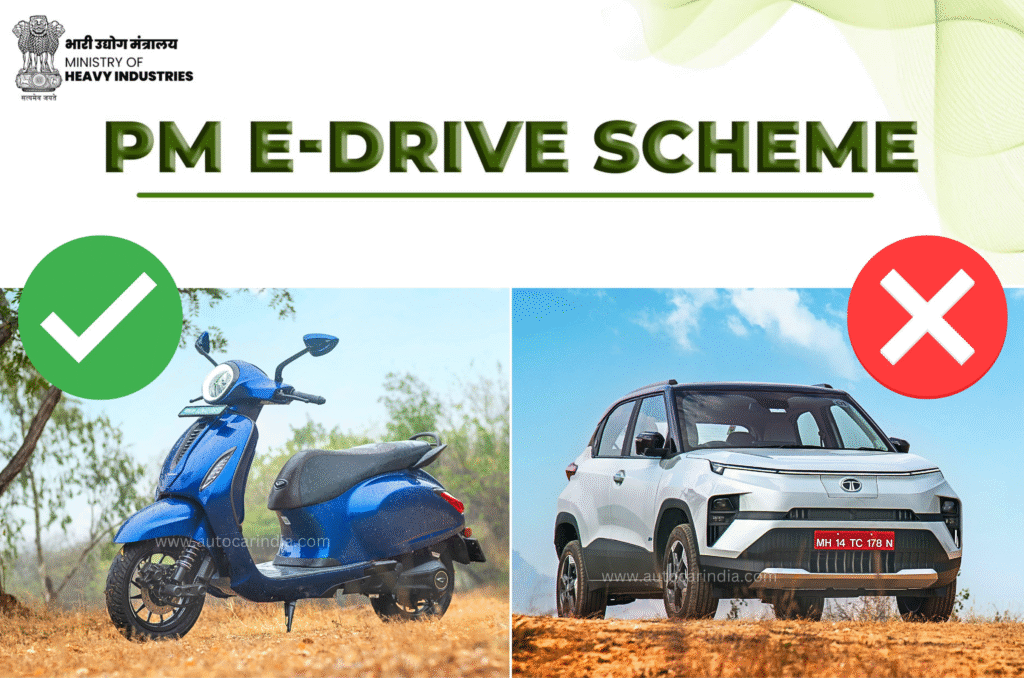
- Electric Two-Wheelers (e-2Ws): Both commercial and privately owned e-scooters and e-bikes with advanced batteries are eligible.
- Electric Three-Wheelers (e-3Ws): This includes registered e-rickshaws, e-carts, and L5 category vehicles, mainly for commercial use.
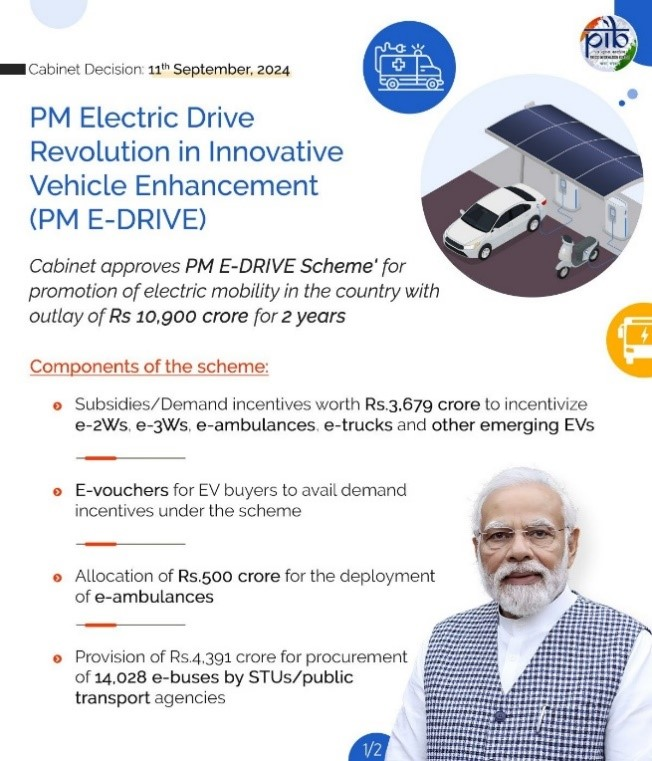
- Electric Trucks (e-Trucks): A significant $\text{Rs. 500 crore}$ has been allocated to encourage the use of e-trucks, a major step towards cleaner logistics.
- Electric Ambulances (e-Ambulances): Another $\text{Rs. 500 crore}$ is set aside to boost the deployment of e-ambulances, promoting comfortable and zero-emission patient transport.
- Electric Buses (e-Buses): The scheme earmarks a massive $\text{Rs. 4,391 crore}$ to support Public Transport Authorities in procuring over 14,000 e-buses for major cities.
Solving the Range Anxiety Challenge
One of the biggest concerns for anyone considering an EV is “range anxiety”—the fear of running out of battery before finding a charging station. The PM E-DRIVE scheme tackles this head-on with a massive push for charging infrastructure.
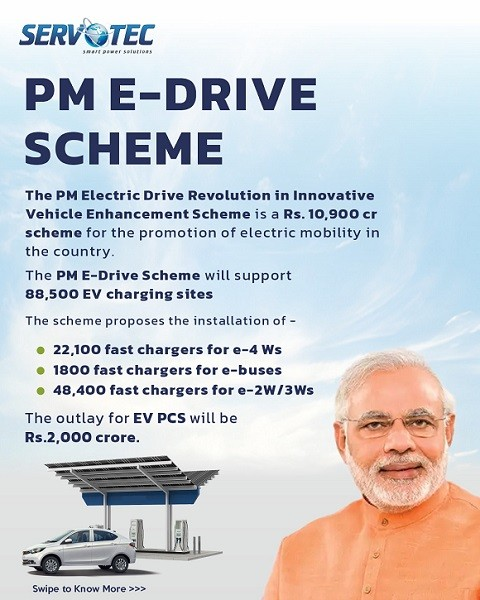
A budget of $\text{Rs. 2,000 crore}$ has been allocated specifically to install thousands of Electric Vehicle Public Charging Stations (EVPCS) across the country. These new charging points will focus on cities with high EV adoption and will also be set up along key highways to enable smoother intercity electric travel.
This focus on building a robust charging network is just as crucial as the subsidies. After all, a cheaper EV is only useful if you can charge it conveniently!
Promoting ‘Make in India’ for EVs
Beyond the benefits for consumers, the PM E-DRIVE scheme is also a powerful driver for the domestic EV manufacturing ecosystem.
The policy includes a Phased Manufacturing Programme (PMP) requirement. This essentially mandates that electric vehicle manufacturers must increasingly localize their production and supply chain in India. Why is this important? It ensures that the subsidies are boosting the national economy, creating jobs along the supply chain, and reducing India’s reliance on imported components, especially batteries and other advanced automotive technology. It’s a key part of the government’s push for Aatmanirbhar Bharat (self-reliant India).
Finally, the scheme also sets aside funds for upgrading vehicle testing agencies, making sure that new EVs adhere to the highest safety and performance standards right here in India.
The PM E-DRIVE scheme is more than just a temporary subsidy; it’s a holistic, two-year strategy to fundamentally change the face of mobility in India. It supports the buyer with reduced prices and bolsters the industry by demanding local manufacturing and supporting a critical charging network.
PM E-DRIVE Scheme: Key Information at a Glance (2024–2026)
| Feature | Detail | Explanation & Insight |
| Full Name of Scheme | PM Electric Drive Revolution in Innovative Vehicle Enhancement (PM E-DRIVE) Scheme | This name highlights the focus on a “revolution” in vehicle enhancement, clearly aiming for innovation in e-mobility. |
| Launch Date | September 29, 2024 (Notification Date) | The scheme was notified by the Government of India through the Ministry of Heavy Industries. |
| Effective Period | October 1, 2024, to March 31, 2026 | This two-year window provides a defined timeline for manufacturers and buyers to plan their investments and purchases. |
| Total Financial Outlay | $\text{Rs. 10,900 Crore}$ | A significant budget dedicated to promoting electric mobility across different sectors, replacing the previous FAME-II program. |
| Governing Ministry | Ministry of Heavy Industries (MHI) | MHI is responsible for the overall monitoring, sanctioning, and successful implementation of the scheme. |
| Primary Objective | Accelerate the adoption of Electric Vehicles (EVs) in the country. | Focuses on reducing reliance on fossil fuels, lowering emissions, and boosting the domestic EV manufacturing ecosystem. |
| Incentive Mechanism | Demand Incentives (Upfront Reduction in Purchase Price) | The subsidy is directly passed on to the consumer (buyer) at the time of purchase via an Aadhaar-authenticated e-Voucher. OEMs are then reimbursed by MHI. |
| Eligible Vehicle Categories | e-2Ws (Two-wheelers), e-3Ws (Three-wheelers), e-Ambulances, e-Trucks, e-Buses, Charging Infrastructure, and Testing Agencies. | The focus is strongly on mass and commercial mobility, providing a powerful boost to public transport and logistics. |
| Mandatory Requirement | Vehicles must be registered under CMVR and fitted with Advanced Batteries. | This ensures that only high-quality, modern EVs that meet specified safety and performance standards are eligible for the benefits. |
| Geographical Scope | Pan India (All of India) | The scheme is applicable across all states and union territories, with a special focus on major cities (like Delhi, Mumbai, Bengaluru, etc.) for e-Bus deployment. |
| Charging Infrastructure Target | $\text{Rs. 2,000 Crore}$ allocated for EVPCS. | Aims to install a massive number of fast chargers for 2Ws, 3Ws, 4Ws, and e-Buses to tackle range anxiety. |
If you are planning to purchase an eligible two-wheeler or three-wheeler, the initial incentive is higher in the first financial year (FY 2024–25), with the subsidy rate reducing in the second year (FY 2025–26). This means acting sooner rather than later can maximize your financial benefit!
#PME-DRIVE#ElectricVehicleScheme#MinistryOfHeavyIndustries (MHI)#GovementScheme#NewIndiaMobility
#ElectricVehicles#EVs)#ElectricMobility#SustainableTransport#GreenMobility#MakeInIndiaEV
#AutoIndustryIndia