
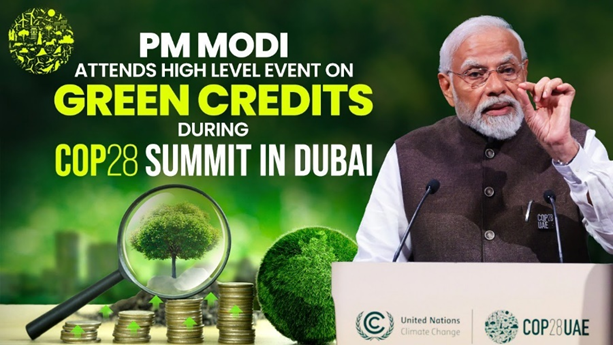
India is launching a significant shift in its environmental strategy with the Green Credit Programme (GCP). Think of it as a market-based mechanism designed to encourage voluntary positive environmental actions by individuals, communities, private sector industries, and even government organizations.
The basic idea is simple yet powerful: if you take an action that benefits the environment—like planting trees, conserving water, or managing waste sustainably—you get a “Green Credit.” This credit is a measurable, tradeable unit that can then be bought and sold on a domestic market platform.
A Fresh Approach to Environmental Incentives
For years, the focus has often been on penalizing polluters or mandating certain environmental practices. The GCP, however, flips this script. It uses a positive incentive approach.
Imagine a large corporation that needs to fulfill its Corporate Social Responsibility (CSR) goals or wants to demonstrate its commitment to sustainability. Instead of just funding a project, they could purchase Green Credits generated by a local community or farmer that successfully restored a degraded piece of land. This direct transaction provides financial value to the positive environmental effort, making conservation economically viable.
Key Areas Covered by the Green Credit Programme
The GCP isn’t just about tree planting; it’s a holistic framework covering several crucial environmental sectors. This variety is what makes it unique and scalable. Initially, the program focuses on eight types of activities:
- Afforestation: Planting trees on degraded or wasteland. This is one of the most direct ways to earn credits.
- Water Conservation and Harvesting: Building and maintaining water harvesting structures, or restoring water bodies.
- Sustainable Agriculture: Promoting eco-friendly farming practices that reduce chemical use and restore soil health.
- Waste Management: Efforts in segregation, recycling, and reduction of waste, moving toward a circular economy.
- Air Pollution Reduction: Implementing technologies or practices that actively reduce air pollutants.
This broad scope ensures that people in different regions and sectors can all participate and contribute to India’s climate goals.
Why Is This a “Revolution” for India?
The GCP has the potential to fundamentally change how environmental responsibility works in India:
- Monetizing Conservation: It transforms environmental good deeds from a simple expense into a financial asset. When an environmental action has a market price, it becomes a much stronger motivator for participation.
- Decentralized Action: This isn’t a program dictated only by the central government. It empowers local people, farmers, and small landowners to become active participants and earners in the sustainability movement.
- Measurable Impact: Green Credits are standardized. This means every activity is measured using transparent, scientifically robust methodologies developed by the Indian Council of Forestry Research and Education (ICFRE). This ensures that a credit earned in one state has the same, verifiable environmental value as a credit earned elsewhere.
This system effectively creates a demand-driven model for ecological restoration, providing a sustainable financing mechanism that complements government efforts.
An Insight: How It Differs from Carbon Credits
While the GCP sounds similar to the international Carbon Credit market, there’s a key difference. Carbon Credits strictly focus on reducing or removing greenhouse gas emissions .
The Green Credit Programme is much broader. While afforestation does sequester carbon, the GCP also rewards actions focused purely on water, land, and biodiversity, which may not be directly tied to carbon emissions. It’s a mechanism dedicated to the holistic well-being of the local ecosystem, not just the global climate balance.
This is India’s unique way of incentivizing actions that matter most for its specific ecological challenges.
The Green Credit Programme is essentially turning environmental stewardship into a tangible, valuable commodity. As this market matures, we can expect a significant increase in voluntary, positive environmental efforts across the country. It’s a strong signal that India is moving towards an era where “going green” also means a sound economic choice.
The Green Credit Programme (GCP): Essential Information at a Glance
| Feature | Details |
| Launch/Notification Date (शुभारंभ / अधिसूचना) | The Green Credit Rules, 2023 were officially notified on October 12, 2023. |
| Administering Ministry (प्रशासक मंत्रालय) | Ministry of Environment, Forest and Climate Change (MoEFCC), Government of India. |
| Primary Objective (मुख्य उद्देश्य) | To create a market-based mechanism that incentivizes and rewards voluntary positive environmental actions by individuals, communities, and companies. |
| Scope of Application (लागू क्षेत्र) | Nationwide (Purely voluntary and applicable across all sectors and regions of India). |
| Duration/Validity (अवधि / वैधता) | The programme is ongoing; it is not a fixed-term scheme. Credits issued have a defined validity period, though the programme itself is a permanent policy tool. |
| What is a Green Credit? (ग्रीन क्रेडिट क्या है?) | It is a singular, measurable, and tradeable unit of incentive for an environmental positive action. It can be bought and sold on a designated trading platform. |
| Issuing Authority (Administrator) (जारी करने वाला प्राधिकरण) | Indian Council of Forestry Research and Education (ICFRE) is designated as the administrator. |
| Key Activities Covered (The 8 Focus Areas) (मुख्य गतिविधियाँ) | 1. Tree Plantation (Afforestation) |
| 2. Water Conservation & Harvesting | |
| 3. Sustainable Agriculture | |
| 4. Waste Management | |
| 5. Air Pollution Reduction | |
| 6. Mangrove Conservation & Restoration | |
| 7. Ecomark Label Development | |
| 8. Sustainable Building & Infrastructure | |
| Difference from Carbon Credits (कार्बन क्रेडिट से अंतर) | GCP is broader. It rewards actions related to water, biodiversity, waste, etc. Carbon Credits focus only on reducing or removing $\text{CO}_2$ emissions. |
| Compliance Mechanism (अनुपालन तंत्र) | The rules provide a framework for methodology, registration, and verification of environmental actions to ensure credits are issued based on a scientifically sound assessment. |
#GreenCreditProgramme #GreenCreditIndia #SustainableIndia #GoGreen2025 #ClimateActionIndia #EcoFriendlyInitiative #CleanIndiaGreenIndia #MissionLiFE #GreenRevolution2025 #PMModiInitiative #Carrerbook#Anslation#EcoSustainability #CarbonNeutralIndia #SaveEnvironment #PlantMoreTrees #RenewableFuture #SustainabilityGoals #GreenGrowth #EnvironmentalConservation #IndiaForNature #GreenFuture