
The agriculture sector is the backbone of India, yet many regions struggle with low crop yields and limited resources. To tackle this, the government has launched a massive, new initiative: the Pradhan Mantri Dhan-Dhaanya Krishi Yojana (PMDDKY). Think of this as a targeted, six-year mission to inject modern technology, better infrastructure, and crucial financial support directly into the areas that need it most.
This isn’t just another small scheme; it’s a huge commitment, inspired by the successful ‘Aspirational Districts Programme,’ but focused entirely on farming. It’s designed to transform the lives of millions of farmers by making agriculture more resilient, profitable, and sustainable.
What Exactly is the Dhan-Dhaanya Yojana?
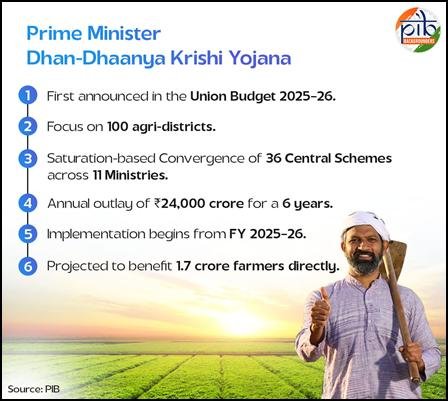
The PMDDKY is a long-term, focused program with a substantial budget of ₹24,000 crore annually for six years, starting from the Financial Year 2025–26. Its core strategy is based on convergence, meaning it brings together 36 existing Central schemes under 11 different ministries to work in a coordinated way.
- The Big Goal: To boost crop productivity, increase farmer income, and ensure food security by promoting sustainable, climate-resilient farming systems.
- The Scale: The scheme targets approximately 1.7 crore farmers directly.
How Are the Target Districts Selected?
The program’s unique strength is its laser-like focus. Instead of spreading resources thinly, the scheme zeroes in on 100 underperforming agricultural districts across the country.
These districts were identified using specific metrics to ensure the aid goes where the challenges are greatest. A few of the key criteria for selection include:
- Low Agricultural Productivity: The land produces significantly less yield compared to the national average.
- Low Cropping Intensity: The land is not utilized for as many crop cycles as it could be in a year.
- Limited Credit Disbursement: Farmers in the area have poor access to formal, affordable bank loans and credit facilities.
Relatable Example: Imagine two villages: one where every farmer gets three good harvests a year with modern tools, and another where farmers only manage one small, rain-dependent crop. This scheme aims to bring the second village’s potential up to the first, with at least one district selected from every state/UT to ensure balanced coverage.
Core Objectives: A Plan for Real Change
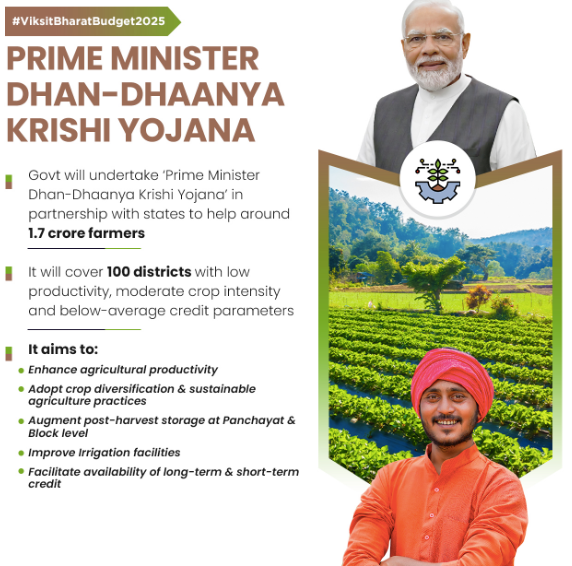
The mission of PMDDKY is multi-faceted, addressing every part of the farming lifecycle, from the field to the market.
1. Enhancing Farm Productivity
This is about getting more yield from the same plot of land. This involves supplying better-quality seeds, promoting advanced farming technology like precision agriculture, and offering training on the best modern techniques.
2. Boosting Crop Diversification
Relying on a single crop can be risky. The scheme encourages farmers to switch to or include higher-value crops, such as pulses, oilseeds, and horticulture products. This not only offers better income stability but also improves soil health and nutritional security for the community.
3. Improving Irrigation Infrastructure
Water scarcity remains a huge obstacle. The program heavily invests in water-efficient technologies like drip and sprinkler irrigation systems to save water and ensure crops have what they need, making farming more reliable even in dry seasons.
4. Augmenting Post-Harvest Storage
It’s a tragedy when a good harvest goes to waste. The scheme prioritizes building new storage and processing facilities at the Panchayat and Block levels. This cuts down on post-harvest losses and gives farmers better control over when they sell their produce, helping them get fairer prices.
5. Facilitating Access to Credit
A farmer needs capital to invest in quality inputs. The PMDDKY works to simplify the process of obtaining both short-term and long-term agricultural loans, making it easier for farmers to buy necessary equipment or adopt expensive but vital new practices.
The Power of Digital Monitoring and Local Action
How will the government ensure this massive project stays on track? Through modern governance:
- Local Ownership: At the grassroots level, a District Dhan-Dhaanya Samiti (committee) is responsible for creating a tailored plan for their area. These committees include local officials and, crucially, progressive farmers who understand the ground realities.
- Digital Tracking: Progress is monitored transparently using a dedicated digital dashboard that tracks over 117 Key Performance Indicators (KPIs) monthly. This data-driven approach allows for quick identification and correction of issues, ensuring the benefits reach the intended beneficiaries.
The PM Dhan-Dhaanya Krishi Yojana represents a forward-thinking investment in India’s agricultural future, promising a significant uplift for millions of rural families by addressing their most pressing challenges head-on.
Key Information on the PM Dhan-Dhaanya Krishi Yojana (PMDDKY)
This initiative is a major government intervention designed to revitalize agriculture and boost farmer incomes in India.
| Feature | Details | SEO/Reader-Friendly Insight |
| Scheme Name | Pradhan Mantri Dhan-Dhaanya Krishi Yojana (PMDDKY) | A comprehensive, flagship scheme dedicated to agricultural transformation. |
| Announcement | Union Budget 2025–26 (February 2025). | The plan was introduced as a major multi-year commitment to farmers. |
| Cabinet Approval | July 16, 2025. | Officially approved to begin the full-scale implementation process. |
| Start Date | Financial Year (FY) 2025–26. | It is scheduled to provide benefits for the next six farming seasons. |
| Total Duration | Six years (FY 2025-26 to 2030-31). | A long-term commitment focusing on sustainable, lasting improvement. |
| Budget Outlay | ₹24,000 crore annually. | Represents a substantial financial investment in the agricultural sector. |
| Target Coverage | 100 underperforming agricultural districts. | Resources are concentrated in regions where the need for reform is highest. |
| Estimated Beneficiaries | Approximately 1.7 crore farmers (primarily small and marginal). | Direct support aimed at uplifting millions of rural households. |
| Inspiration Model | NITI Aayog’s ‘Aspirational Districts Programme’. | Adopts a proven, focused development and convergence strategy. |
| Implementation Strategy | Convergence of 36 existing Central schemes across 11 Ministries. | Eliminates redundancy and ensures coordinated action across government departments. |
| District Selection Criteria | * Low Agricultural Productivity. * Low Cropping Intensity. * Limited Credit Disbursement. | Targets are based on measurable weaknesses to maximize impact. |
| Core Objectives | * Enhance agricultural productivity. * Promote crop diversification. * Improve irrigation facilities. * Augment post-harvest storage. * Facilitate farm credit access. | A holistic approach covering the entire cycle, from seed to market. |
| Monitoring | Monthly tracking via a digital dashboard using 117 Key Performance Indicators (KPIs). | Ensures transparent, data-driven governance and fast problem resolution. |
#PMDDKY #DhanDhaanyaYojana #KrishiYojana #PMDhanDhaanyaGeneral Agriculture#IndianAgriculture #FarmerWelfare #KisanKalyan #AgriTech #RuralDevelopmentFinancial & Policy#FarmCredit #Carrerbook#Anslation#AgricultureScheme #GovernmentInitiative #NewEraForFarmers #AatmanirbharBharatFocus Areas#CropDiversification #SmartFarming #FarmProductivity #IrrigationProject #PostHarvestTrend & Reach#ModiGovernment #IndiaNews #NewScheme #FarmersFirst #DigitalIndia